Small Batches, Big Numbers: The Hometown Economics of Kiwanis Fundraising
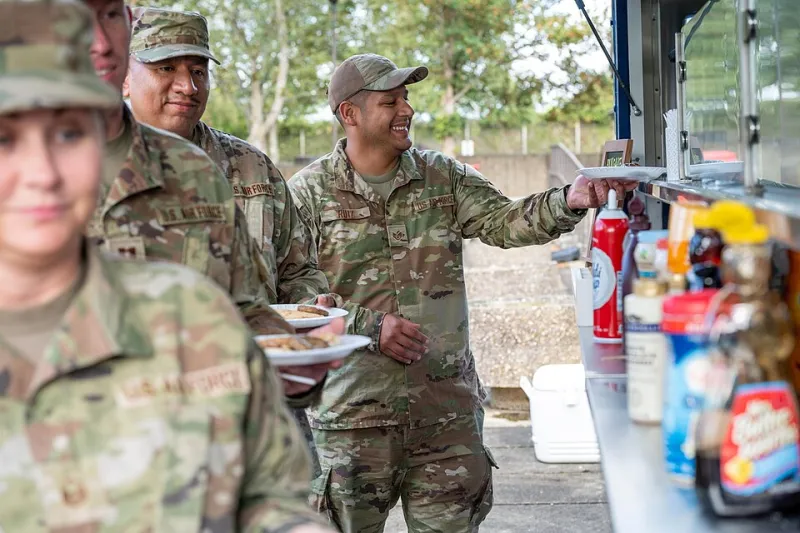
Photo: U.S. Air Force photo by Tech. Sgt. Jessica Avallone, Public domain, via Wikimedia Commons
There is a moment, familiar to anyone who has ever worked a church basement griddle at six on a Saturday morning, when the arithmetic of small-town fundraising stops making sense on paper. Two hundred breakfasts at eight dollars a plate. Sixteen hundred dollars, minus the cost of sausage and syrup. It seems like small change.
Multiply that modest figure by thousands of clubs, across hundreds of weekends, and the picture changes entirely. Add Christmas tree lots, duck races, golf scrambles, and nut sales, and the cumulative total climbs into the tens of millions of dollars annually — an enormous, decentralized engine of charitable giving that operates almost entirely below the radar of national nonprofit coverage.
The Griddle as Economic Engine
The pancake breakfast endures not because it is efficient in the corporate sense, but because it is efficient in the human one. Overhead is minimal: clubs often secure donated venues from schools, fire halls, and church basements. Supplies come from local grocers who understand the reciprocal value of goodwill. Labor is free and, notably, enthusiastic — members work the event because working the event is, in many ways, the point.
Economists who study nonprofit efficiency tend to focus on the ratio of program spending to administrative cost. By that measure, the hometown fundraiser is a marvel. Nearly every dollar that crosses the table goes back out the door to the community, whether in the form of college scholarships, coats for schoolchildren, or a sensory-friendly playground.
But the true economics are subtler still. A well-run fundraiser generates three distinct assets: money, visibility, and membership. The breakfast that clears two thousand dollars also introduces the club to two hundred neighbors, several of whom will eventually join. In fundraising terms, that is a customer acquisition cost of zero.
A Taxonomy of the Hyper-Local
The variety of Kiwanis fundraising traditions borders on the folkloric. In some river towns, the annual duck race has become a civic ritual: thousands of numbered rubber ducks released into a creek, with the winning duck's sponsor claiming a prize donated by a local business. In northern states, the Christmas tree lot is a December institution — a member-staffed operation that transforms an empty lot into a seasonal landmark and a reliable revenue stream for the year's children's programs.
Elsewhere, clubs run consignment sales for children's clothing, sell citrus and nuts by the case, host trivia nights, and organize charity runs that double as community festivals. What unites these efforts is not their format but their scale: each one is sized precisely to its town, run by people who know exactly which local businesses will donate and which families will show up.
What National Nonprofits Could Learn
Large charitable organizations spend considerable sums studying donor acquisition, and it is here that the hometown model offers an uncomfortable lesson. National nonprofits routinely pay acquisition costs of fifty cents to a dollar or more per dollar raised from new donors. The Kiwanis breakfast acquires donors at essentially no cost, retains them through social connection rather than mail campaigns, and converts a meaningful percentage into volunteers.
The mechanism is simple: people give more, and give longer, to causes they can see, touch, and attend. When a donor's eight dollars buys a plate of pancakes served by a neighbor, the transaction is not merely charitable — it is communal. The donor is not a line item in a CRM; she is a guest.
There is also a governance lesson. Because club members decide locally how funds are spent, the money moves quickly and visibly. A scholarship is awarded at the high school assembly in May. The playground equipment arrives in October. Donors witness the full arc from fundraiser to outcome, closing the trust loop that so often breaks in larger institutions.
Keeping the Griddle Warm
None of this is to suggest that the model is without challenges. Clubs, like the towns they serve, are navigating changing work patterns and competition for volunteer hours. Some traditions — the multi-day tree lot, the hundred-dozen pancake marathon — strain the capacity of smaller memberships.
Yet the institutions show a striking capacity for adaptation. Clubs now run online ordering for breakfast pickups, use social media to promote duck adoptions, and coordinate multi-club events that pool volunteers and widen reach. The form evolves; the function endures.
The forty-million-dollar pancake, it turns out, is not really about the pancake. It is about what happens when a community is asked to show up, eat together, and hand a few dollars to neighbors they trust. National philanthropy spends fortunes trying to manufacture that trust. In fire hall basements across America, it shows up free every Saturday morning.